The best time for an Abashiri drift ice cruise
The ice off Abashiri keeps no timetable. It usually turns up in late January, packs the coast through February and drifts away during March, but every winter shifts those dates a little. Pick your week well and you raise the odds, though nobody can promise ice on the day you sail.
When the ice usually comes
Drift ice, called ryuhyo in Japanese, forms far to the north in the Sea of Okhotsk and travels south with the wind and the currents. In most years the first floes reach the Abashiri coast in the second half of January. The pack tends to be thickest through February and into early March, and it starts to break up and pull away during March. Each of those dates moves from one winter to the next, sometimes by a couple of weeks, and some winters bring far less ice than others.
The Aurora works around the same calendar. JUN Travel's listing says the ship usually sails from late January to March. Club Tourism's listing adds that it sails whether there is ice or not, so in the thin weeks at either end you may get a plain sightseeing cruise on open water. What you see from the deck describes the difference between a full pack and a few scattered floes.
| Period | Ice off Abashiri, usually | The Aurora |
|---|---|---|
| Mid January | Rarely at the shore yet | Before the sailing window the listings describe |
| Late January | First floes, patchy, can come and go within days | Usually starting its season |
| February | The thickest and most dependable weeks | Sailing, with the busiest weekends |
| Early March | Often still good, thinning toward the middle of the month | Sailing, a little calmer on board |
| Late March into early April | Breaking up, often gone from the coast | Can still sail as a sightseeing cruise on open sea |
February into early March
If your dates are free, aim for this stretch. The ice has usually settled along the coast by early February, and the cold that keeps it there holds for several weeks. A Garinko listing in Monbetsu, farther up the same coast, gives a similar picture, with drift ice generally from late January to mid-March and the strongest weeks in February and early March. That matches what the Abashiri tours describe, which is reassuring, since nobody here runs a long record of their own.
Late January can be lovely when the ice arrives early, and late March can still surprise you, but both carry more risk of open water. If you can only travel at the edges of the season, read what each tour does when the ice stays away before you book, because the three Aurora tours handle it differently.
The wind decides the day
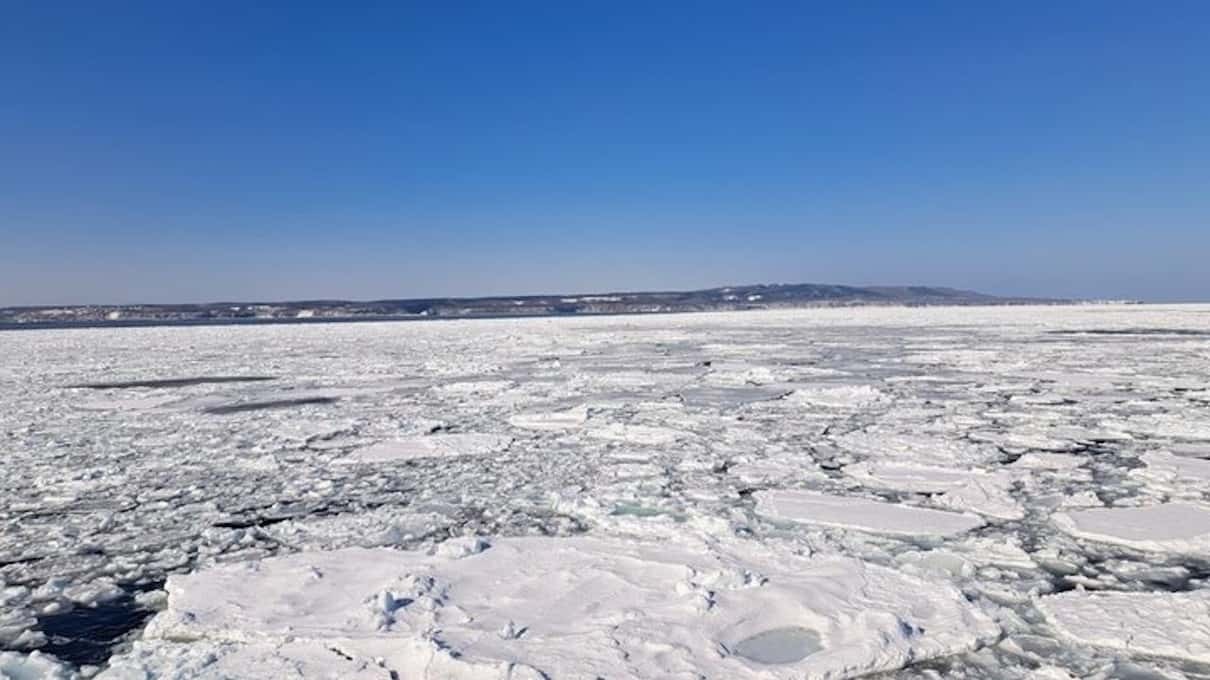
Even in a good February the ice is not fixed in place. It floats, and the wind pushes it around. A steady north wind packs the floes hard against the Abashiri shore, which is when the ship grinds through a solid white field. A south wind does the opposite and can push the pack several kilometers offshore in a single night, leaving the harbor mouth clear. Locals talk about the ice arriving or leaving overnight, and that is no exaggeration.
So the week you choose only sets the odds. The forecast for the day before sailing tells you more, and so does the view from the shore that morning. Treat ice as a likely bonus in February and as luck at either end of the season. Seals and sea eagles are never guaranteed either, whatever the month.
Morning or afternoon sailing
Winter days in eastern Hokkaido are short. The sun sets early, roughly between 4:30 and 5 pm in February, and the light is low and gold for most of the afternoon. Morning sailings tend to give clear, hard light over a white sea, while later ones bring longer shadows and a colder wind as the sun drops. Both look good when the ice is in. The deck feels several degrees colder than the town either way, so what to wear on the icebreaker matters more than the hour.
On the coach tours you do not choose the slot. H.I.S. puts the Aurora on the morning of day 2, before lunch at the Prison Museum. Club Tourism's listing places the cruise on day 2 after Kitahama Station without giving a time. On the private day from JUN Travel, ~$2,082 for a group of up to six, the museums are arranged around the ship's departure time, so the day bends to the sailing rather than the other way round.
Busy weeks and sold-out sailings
February weekends draw the most people, and Chinese New Year brings a wave of visitors from across Asia. That holiday falls in late January or February and moves each year, so check the calendar for your year before picking dates. On busy days the Aurora's sailings can sell out, and a two-day trip built around a cruise that has no seats left is a long ride for little.
This is where a package helps. All three Aurora tours include the fare, and the H.I.S. listing goes further and says it holds a guaranteed booking on the ship. Doing it yourself costs only a few thousand yen at the ticket window, but on a crowded Saturday you take your chances. What the Aurora icebreaker costs sets the tour prices against going on your own.
A seat on the ship, held for you
H.I.S. runs two days from Sapporo with a hot-spring night by Lake Abashiri and the Aurora on day 2, from ~$401 per person. Its listing promises a guaranteed booking on the ship, which counts most on February weekends.
Other winter events on the route
The ice season overlaps with two events the H.I.S. coach passes on day 1. The Sounkyo Ice Waterfall Festival fills a mountain gorge between Asahikawa and Abashiri with lit ice walls and frozen sculptures, and the tour stops for about 30 minutes. Entry costs 1,000 yen on site; the tour price does not cover it. Earlier the same day, Asahiyama Zoo runs its penguin walk, which one tour listing says is held from late December to mid-March. Both make a long coach day easier on children, as the icebreaker with kids explains.
If your dates fall elsewhere on the coast
Some travelers find the Aurora tours do not run on the days they have. The two-day Garinko trip from Sapporo, from ~$427, visits the same drift ice season from another angle. Its catch is plain, it goes to Monbetsu, a different town about 100 km (60 miles) up the coast, and onto a different ship, and it has no reviews yet. Aurora or Garinko compares the two boats. For what fills the rest of a winter day here, see our guide to Abashiri's sights.